
THE BUILDING
A Building That Earned Its Place In Glasgow History
For more than two centuries it has stood at the heart of the Merchant City – a hospital, a hall, a landmark. This is the story of the walls that now hold Saints of Ingram, and the city that grew around them.
01
The Hutcheson Brothers
The story begins not with this building, but with two brothers. George and Thomas Hutcheson were prosperous Glasgow merchants and lawyers in the early seventeenth century. They were men of means in a city that was only beginning to find its commercial feet. In 1639 and 1641 respectively, they left endowments to establish a hospital and a school for the city’s poor and elderly. It was a charitable foundation that would carry their name for centuries.
Their original foundation was created to provide care and support for those in need. Over time, that charitable legacy became tied to this corner of Glasgow, eventually giving rise to the building that still stands on Ingram Street today.
“The statues of the Hutcheson brothers, carved in 1649, are among the oldest pieces of public sculpture in Glasgow. They have watched the city change from the same position for over 375 years.”
02
David Hamilton and the Design of 1802
By the close of the eighteenth century, the foundation commissioned a new hall worthy of its standing. The man chosen for the task was David Hamilton, often called “the father of the profession” in Glasgow. His work would come to define the grammar of the growing city.
Completed in 1802, Hamilton’s design is a confident exercise in neoclassical restraint: a finely proportioned frontage, a soaring steeple, and the rescued statues of George and Thomas Hutcheson set into niches on the façade. They remain there today. Inside, the grand hall was built for ceremony – high ceilings, ornate plasterwork and tall windows that flood the room with light.
It is a building designed to be looked up to, and it has been ever since.
David Hamilton’s neoclassical façade, completed in 1802, remains one of the finest in the Merchant City.
03
Category A Listed
The building holds Category A listed status – the highest level of protection in Scotland, reserved for buildings of national or international importance. Fewer than one in ten listed buildings in the country carry it.
That designation is more than a plaque. It governs how the building may be altered, repaired and used. Hamilton’s proportions, the plasterwork and the historic fabric survive intact for the generations that follow. To work within these walls is to work within a set of obligations as much as opportunities. We consider that a privilege.
04
The National Trust for Scotland
In 1945 the building passed into the care of the National Trust for Scotland, the conservation charity entrusted with safeguarding the nation’s most significant places. For decades it served as offices and a regional headquarters, quietly maintained behind its historic frontage.
That stewardship is the reason the building stands in such fine condition today. So many of Glasgow’s great structures were lost to fire, redevelopment or neglect. This one was protected, its details preserved and its story kept whole.
05
The Merchant City
The streets around the building tell their own story. The Merchant City grew from the wealth of the tobacco and sugar trades of the eighteenth century. It was a grid of warehouses, counting houses and grand townhouses built by Glasgow’s mercantile elite.
Today it is the city’s cultural and culinary heart. Restaurants, galleries and independent shops fill it, the old architecture given new life. Ingram Street runs through the middle of it, and the building sits at one of its most prominent corners, exactly where it has always been.
06
Saints of Ingram Today
Saints of Ingram is the building’s newest chapter. Across three floors we have made it a place to gather again – a steak and seafood restaurant and bar at ground level, a grand hall for wedding receptions and events above, and an intimate room at the top for whisky and cocktail experiences.
Little has been changed and nothing has been hidden. We cook beneath Hamilton’s ceilings, pour against two centuries of history, and invite the city back into a room it has always known. The brothers still watch from the façade. The building is still earning its place.
THE GALLERY
The Building in Images
Hutchesons’ Hall on Ingram Street, the Category A listed home of Saints of Ingram in Glasgow’s Merchant City. Designed by David Hamilton in 1802, its clock tower and spire rise above the statues of George and Thomas Hutcheson at the entrance.
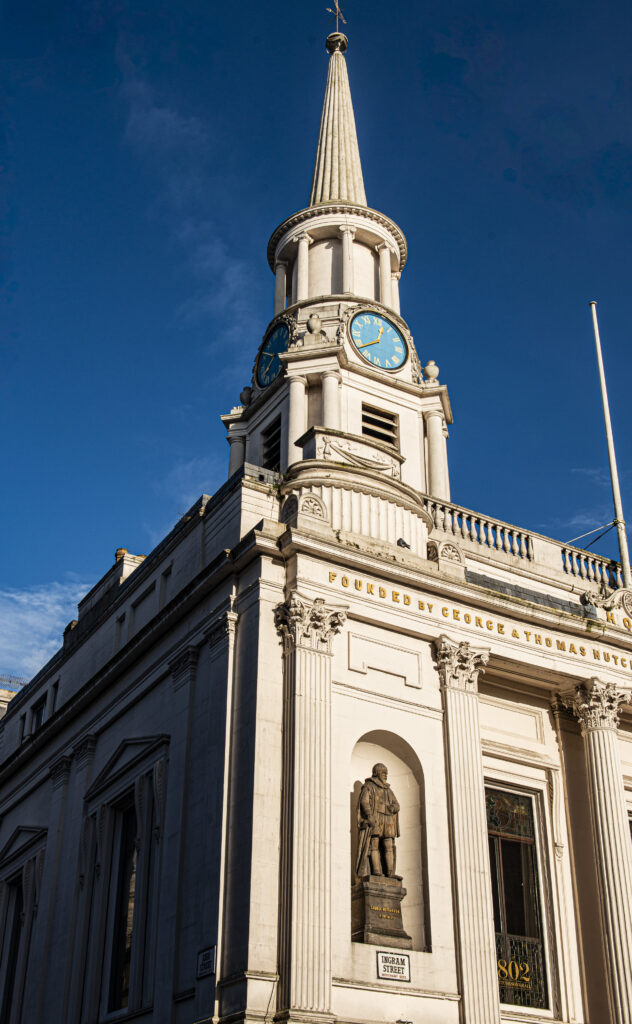
The clock tower and steeple of Hutchesons’ Hall, rising above the corner of Ingram Street in Glasgow’s Merchant City. The carved inscription records the building’s founding by George and Thomas Hutcheson, the Category A listed landmark that is now home to Saints of Ingram.
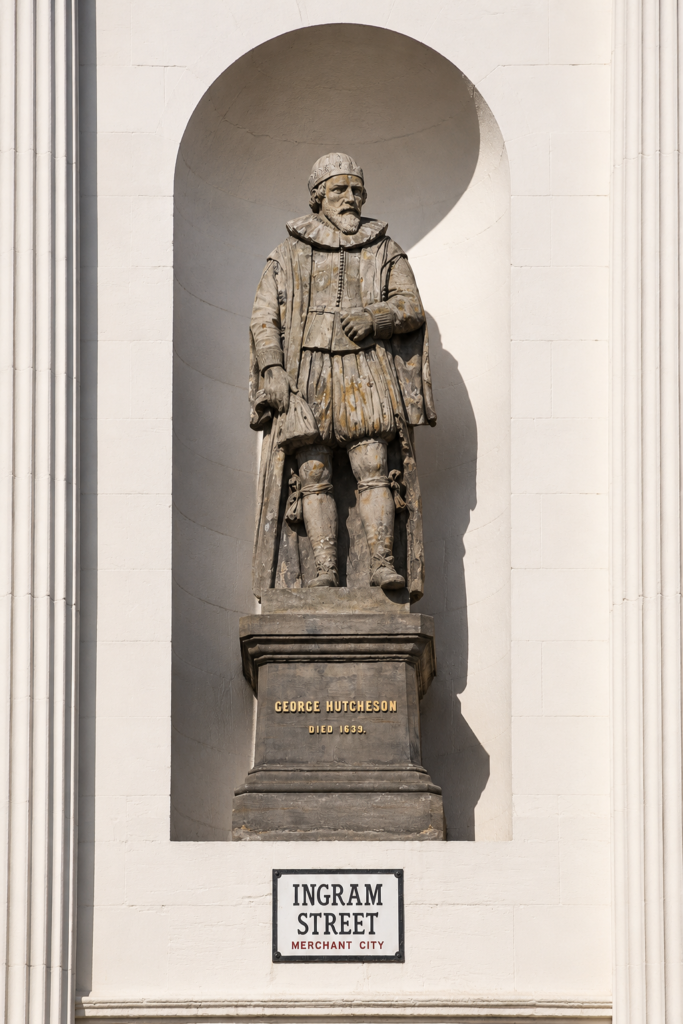
The statue of George Hutcheson set into the facade of Hutchesons’ Hall on Ingram Street, Merchant City. One of two seventeenth-century figures of the brothers who founded the original hospital here, it marks the heritage at the heart of Saints of Ingram.
A carved inscription and Corinthian capitals on the facade of Hutchesons’ Hall, recording its founding by George and Thomas Hutcheson of Lambhill in 1639 and 1641. The original Hutchesons’ Hospital gave the building its name, later rebuilt as the Category A listed landmark on Ingram Street that now houses Saints of Ingram.
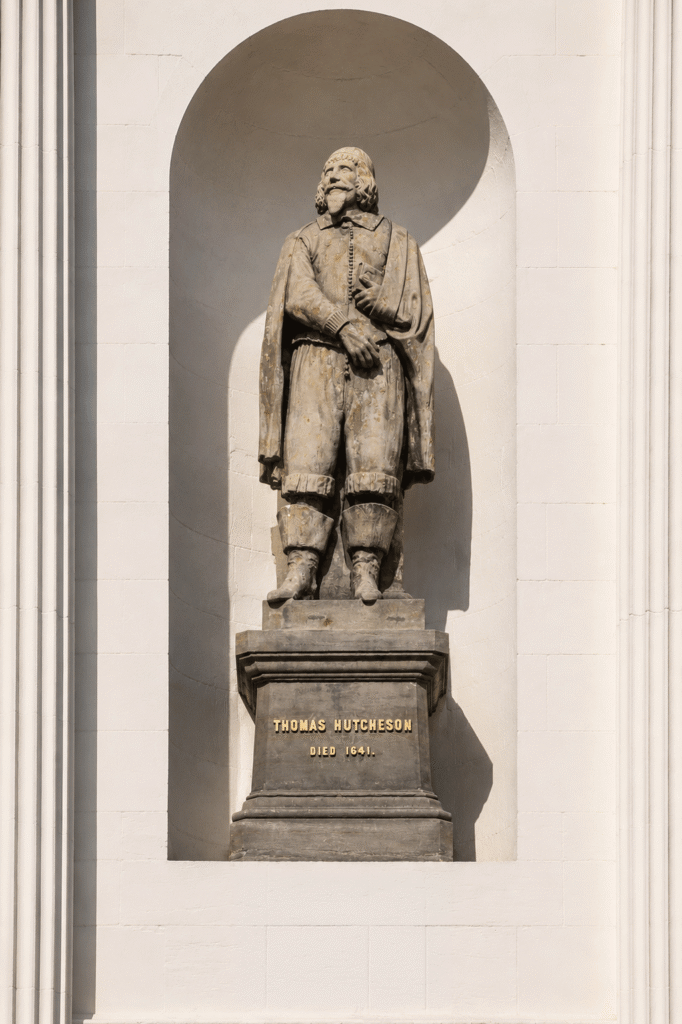
The statue of Thomas Hutcheson on the facade of Hutchesons’ Hall, his plinth marking his death in 1641. With his brother George, he founded the original Hutchesons’ Hospital, the heritage that gives Saints of Ingram its name on Ingram Street in the Merchant City.
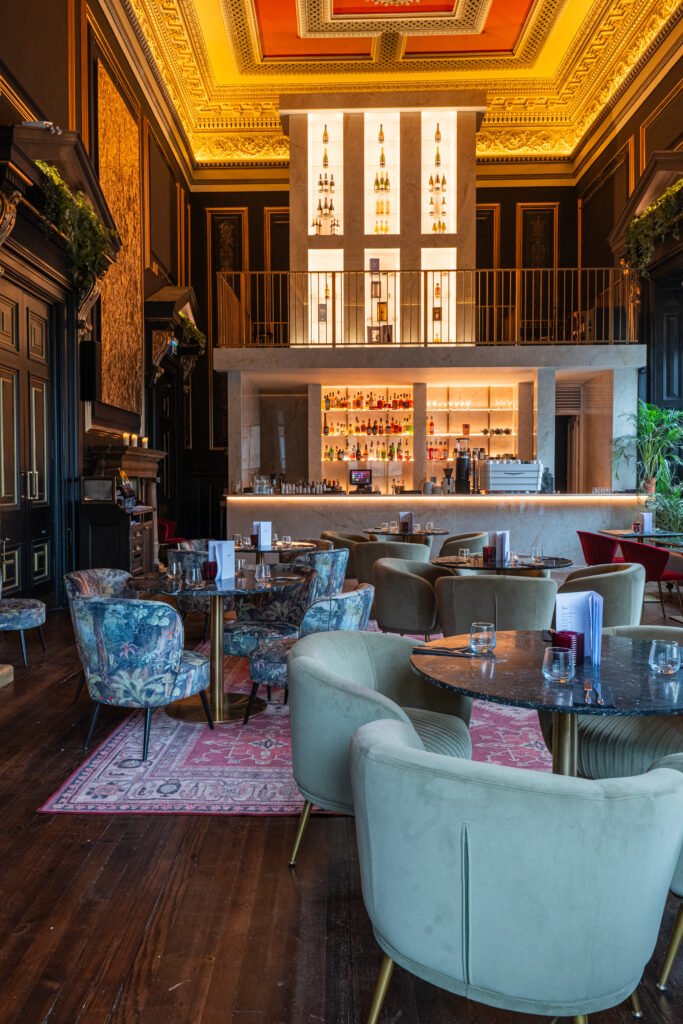
The grand hall on the first floor of Hutchesons’ Hall, beneath its gilded coffered ceiling and mezzanine. This is the setting at Saints of Ingram for receptions, events and private hire in Glasgow’s Merchant City.
The blue and gilded clock face of Hutchesons’ Hall, set into the octagonal steeple above Ingram Street. A landmark of Glasgow’s Merchant City, the tower crowns the Category A listed building that is home to Saints of Ingram.
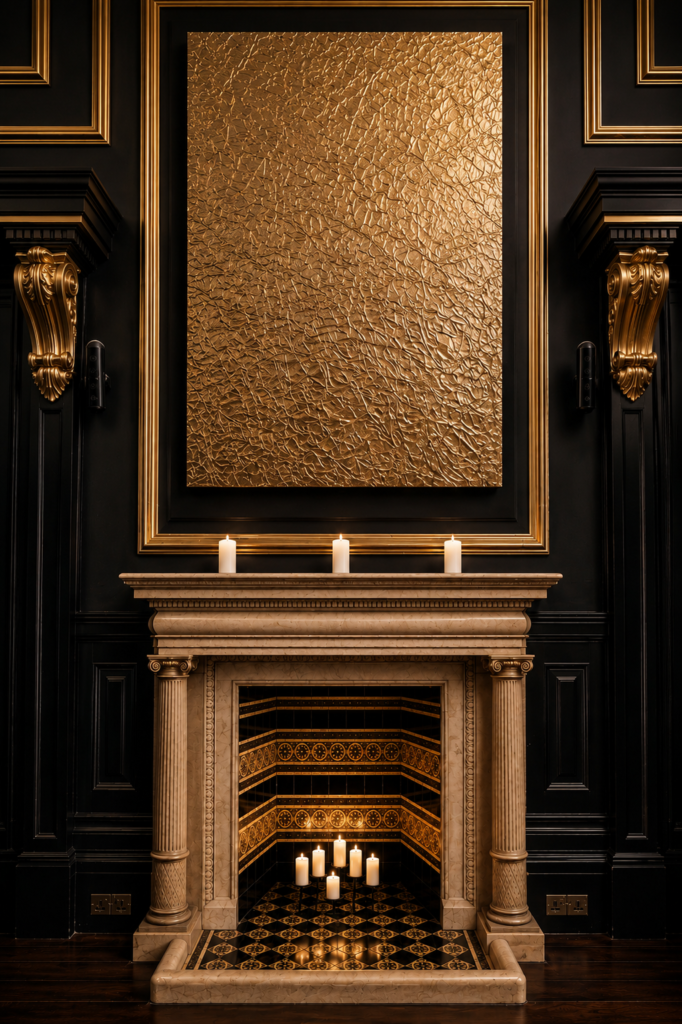
An original marble fireplace in the grand hall on the first floor of Hutchesons’ Hall, framed by carved columns and candlelight. Restored period detail sets the scene at Saints of Ingram for weddings receptions, events and private hire in Glasgow’s Merchant City.
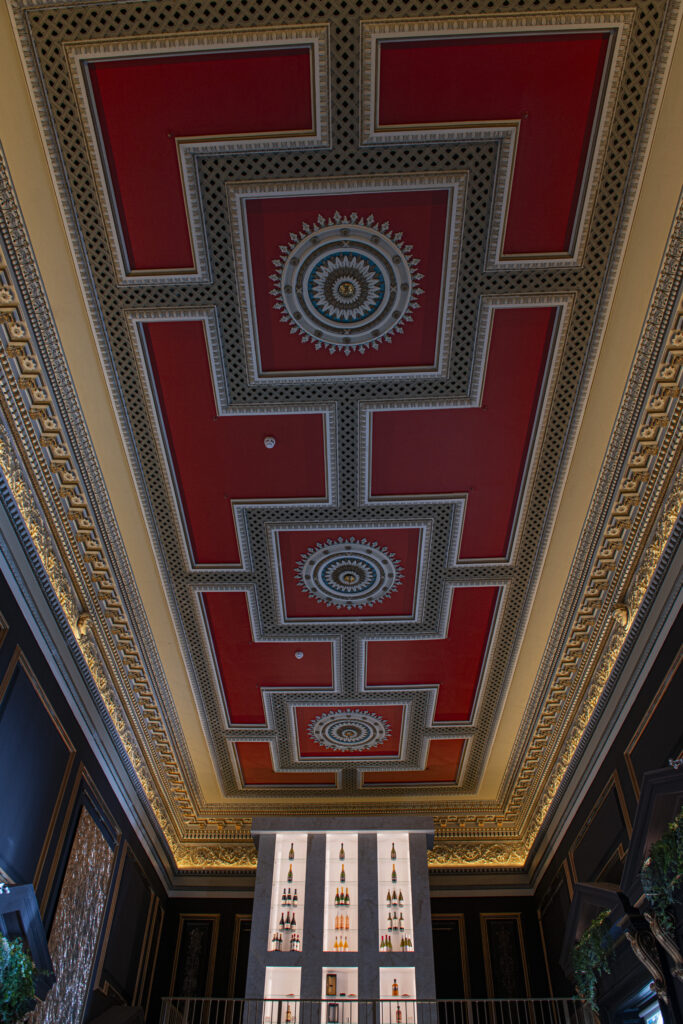
The painted and gilded ceiling of the grand hall at Hutchesons’ Hall, its red and gold coffers rising above the first-floor mezzanine. Designed in John Baird’s 1876 recast of the interior, it crowns the Saints of Ingram setting for receptions and events in the Merchant City.
Please rewrite the content here for the clock tower.
The Preceptors board of the Royal Incorporation of Hutchesons’ Hospital, mounted on the staircase wall at Saints of Ingram. Naming the hospital’s preceptors from the 1640s onward, it records the charitable foundation of George and Thomas Hutcheson that gives Hutchesons’ Hall its name in Glasgow’s Merchant City.
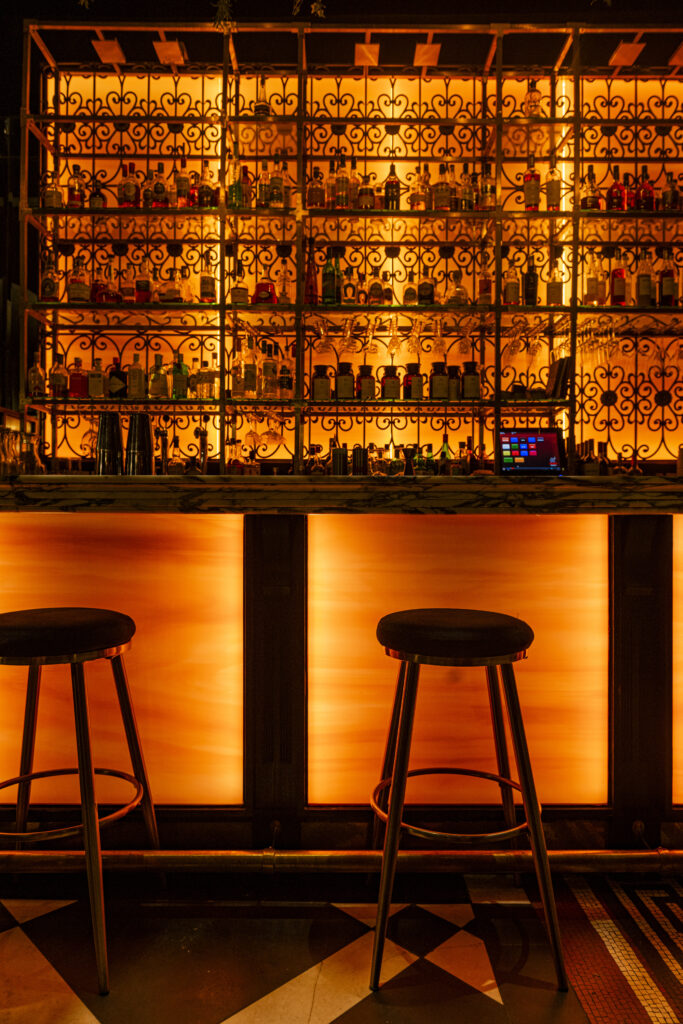
The bar at Saints of Ingram, set in the entrance as you arrive from Ingram Street. Backlit shelves of spirits behind ornate ironwork and a marble counter open the ground floor of Hutchesons’ Hall, with the restaurant just through the door in Glasgow’s Merchant City.
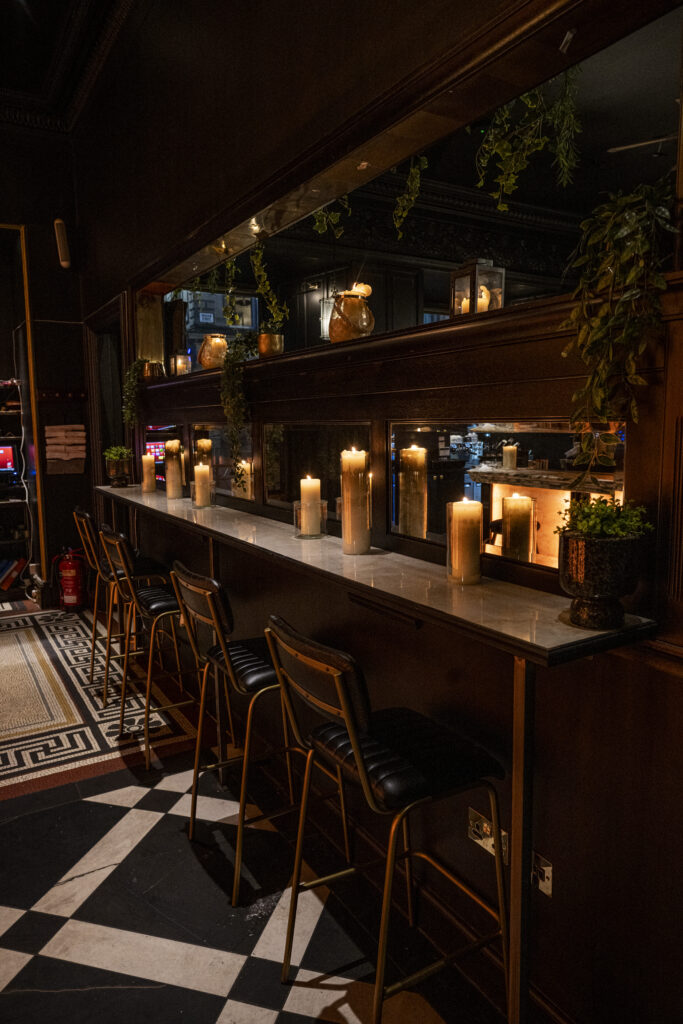
Candlelight along the marble bar at Saints of Ingram, running the length of the entrance corridor on the ground floor of Hutchesons’ Hall. Original mosaic flooring and mirrored walls set the tone on arrival in the Merchant City.