
Most buildings in Glasgow have stories. Hutchesons’ Hall has several centuries of them.
The white Georgian frontage on Ingram Street is one of the most recognisable sights in the Merchant City. The octagonal clock tower reaches 150 feet above street level. The two stone figures flanking the entrance have stood there since the 1820s. Behind the facade is a Grand Hall that has served as a hospital, a library, a banking clearing room, a concert venue and now one of the city’s finest places to eat and celebrate. If you are visiting Saints of Ingram for brunch, dinner or a private event, you are standing inside a building with a history that stretches back to 1641. This is that history.
The Brothers Behind the Building
The story of Hutchesons’ Hall begins not with a building but with two brothers. George Hutcheson was born around 1580. His younger brother Thomas was born in 1589. Both trained as lawyers and became two of the most prosperous men in Glasgow during the early seventeenth century.
George died in 1639. He left a bequest in his will with a specific purpose: to build a hospital in Glasgow for elderly and infirm men. Thomas died two years later in 1641 and added to his brother’s legacy. He funded a school for poor and orphaned boys to be housed alongside the hospital.
Thomas’s decision had an impact that reached far beyond his own lifetime. That school eventually became Hutchesons’ Grammar School, which still operates in Glasgow today.
The two brothers are represented by the stone statues on the south elevation of the current building on Ingram Street. Carved in the seventeenth century by sculptor James Colquhoun, they are the oldest freestanding statues in Glasgow. There is a famous detail about them: when they were reinstated on the new building in the 1820s, after spending decades in storage, they were placed on the wrong plinths. George stands where Thomas should be, and Thomas where George should be. The mistake has never been corrected.
The Original Hospital: Trongate, 1641
The first building to carry the Hutcheson name was constructed on the Trongate in 1641. It housed twelve elderly men and twelve schoolboys at a time. The steeple reached 100 feet and was topped with a clock and bell. Two statues of the Hutcheson brothers stood at the foot of the entrance.
The hospital operated for over 150 years. During that time the city around it changed. Glasgow expanded. Land values in the old town rose. By the 1790s the Patrons of the Hospital faced a practical problem: the Trongate site was needed to create a new street through the heart of the city. That street would take the Hutcheson name: Hutcheson Street.
In 1795 the original building was demolished. The patrons invested the proceeds in a new site on Ingram Street and commissioned a replacement building of far greater ambition. The statues were placed in storage at the Merchants’ House, where they remained until the new building was complete.
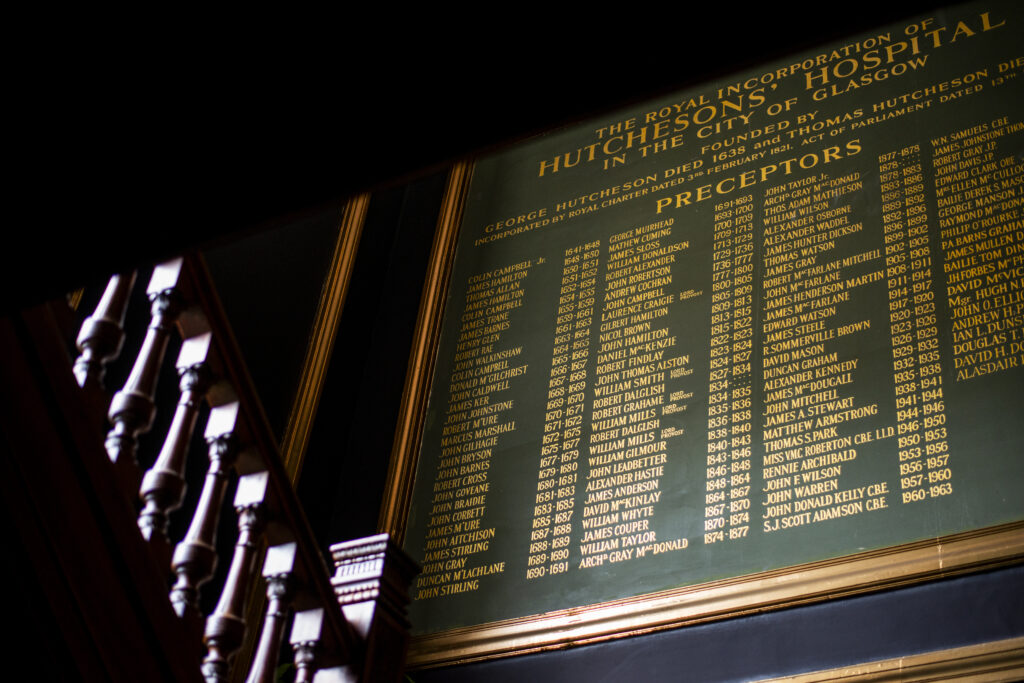
David Hamilton and the Ingram Street Building (1802)
In 1802 the Patrons of Hutchesons’ Hospital commissioned a relatively young architect named David Hamilton to design the new building. He was 34 years old. He would go on to become one of the defining architects of Georgian Glasgow.
Hamilton was born in Glasgow in 1768. He trained as a stonemason before moving into architecture, and his work shows the influence of Robert and James Adam, the brothers whose neoclassical style defined the most admired British buildings of the late eighteenth century. Hamilton’s eye for proportion and his command of classical detail would shape Glasgow’s built environment for the next four decades.
The Ingram Street building was completed in 1805. Hamilton designed it on a strict classical plan: a cube-shaped body with a steeple emerging from its centre. The south elevation features Corinthian columns and fluted pilasters framing a recessed principal storey. A balustraded attic sits above. The two niches for the Hutcheson statues were built into the frontage from the beginning, waiting for the figures to return from storage.
Hamilton went on to design some of Glasgow’s most important buildings. The Royal Exchange on Queen Street, completed in 1829, is now the Gallery of Modern Art. The Nelson Monument on Glasgow Green dates from 1806. The Western Club on Buchanan Street and the Union Bank on Ingram Street, now known as The Corinthian, both date from 1841. Hutchesons’ Hall was his first major civic commission and remains one of his finest.
What to Look for on the Building
If you are approaching from Ingram Street, stop and look up before you go inside. The octagonal clock tower rises from the centre of the building to a height of 150 feet. Clock faces appear on all four compass points. The tower narrows to a circular form before finishing in a fluted cone spire with a ball and weather vane at the very top.
The south elevation displays three tall windows on the first floor, flanked by two Corinthian columns and a pair of fluted pilasters on each side. The statues of George and Thomas Hutcheson sit in niches to the east and west of this central arrangement. The ground floor uses banded ashlar stonework. The whole facade was repainted a gleaming white in 2010.
Inside, the most significant space is the Grand Hall on the first floor. The cornicing, the panelling and the stained glass windows all survived the building’s various periods of renovation. The stained glass includes direct references to the Hutchesons’ Hospital endowment. Portraits of Glasgow worthies line the walls, an informal record of the city’s civic life over two centuries.
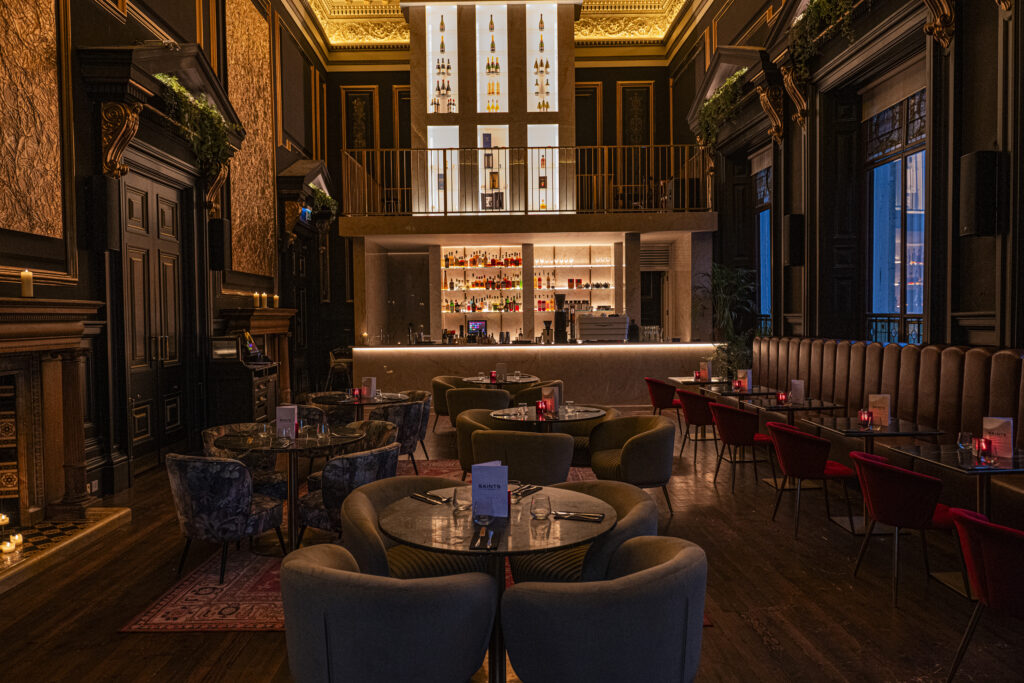
John Baird and the Grand Hall (1876)
The building Hamilton completed in 1805 was not quite the one that exists today. The most significant transformation came in 1876, when architect John Baird II carried out a major remodelling of the interior.
The most radical change was to the Grand Hall. Baird removed the entire second-storey floor, opening the space into the double-height room that visitors experience now. He also added an impressive staircase which remains one of the building’s most striking features. Much of the internal arrangement, the decorative detail and the structural elements that define the hall today date from this 1876 remodelling rather than from Hamilton’s original build.
Further alterations followed in 1983 and 1994. Each intervention sought to preserve the original features while adapting the building for new uses. The result is a layered interior: Hamilton’s classical architecture, Baird’s Victorian additions and the careful restoration work of the late twentieth century all present at once.
Two Centuries of Different Lives
Few buildings in Glasgow have served as many different purposes as Hutchesons’ Hall. The Grand Hall on the first floor housed Stirling’s Library from the time the building opened until 1844. It then became the clearing room for the Glasgow banks. The building later served at various points as a school, a public library, offices and shops.
The National Trust for Scotland acquired the building in 1982 and carried out a full restoration of the Grand Hall in 1987. For a period the Trust used it as a visitor centre with an audio-visual presentation on the history of the Merchant City. The hall hosted concerts, exhibitions and private dinners. The pianist Gusztáv Fenyő gave a celebrated series of Chopin recitals in the hall. The University of Strathclyde held regular lunchtime concerts there.
In 2008 storms caused serious water damage to the interior. The building was closed and remained empty for years. Then in 2014, after an extensive restoration project overseen by specialists working with the National Trust for Scotland, it reopened as a restaurant. The restoration received a Glasgow Institute of Architects Conservation Commendation Award in 2014. The building has been in use as a hospitality venue ever since.
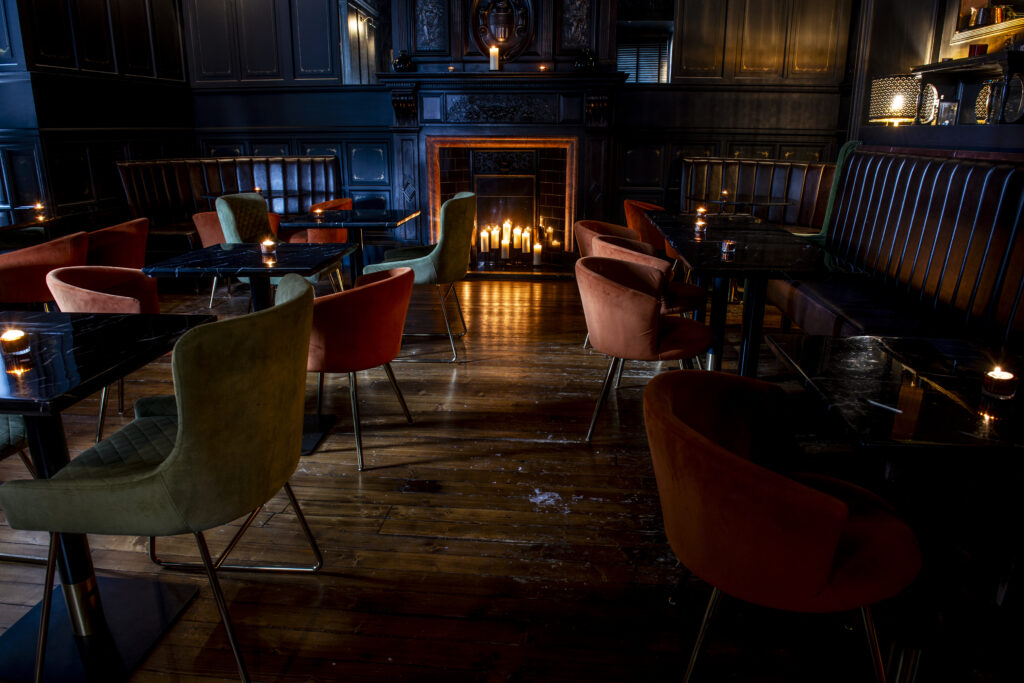
Saints of Ingram and the Building Today
Few buildings in Glasgow have served as many different purposes as Hutchesons’ Hall. The Grand Hall on the first floor housed Stirling’s Library from the time the building opened until 1844. It then became the clearing room for the Glasgow banks. The building later served at various points as a school, a public library, offices and shops.
The Grand Hall is available for private hire throughout the week. Weddings, whisky tastings, corporate events, private celebrations, engagement celebrations and private dining all take place in the same room that has hosted Glasgow’s occasions for over two centuries. You can find out more on our Events & Private Hire page.
The building is Category A listed. That is Scotland’s highest designation for a structure of special architectural or historic interest. It places Hutchesons’ Hall in the same category as Edinburgh Castle and Glasgow Cathedral.
If you would like to experience the building in person, you can book a table online or view our full menus before you visit.
Frequently Asked Questions
Hutchesons’ Hall was designed by Scottish architect David Hamilton and built between 1802 and 1805. Hamilton went on to design many of Glasgow’s most important buildings, including the Royal Exchange (now the Gallery of Modern Art) and the Nelson Monument on Glasgow Green.
The building is named after brothers George and Thomas Hutcheson, two Glasgow lawyers who bequeathed money in the seventeenth century to build a hospital for elderly men and a school for poor boys. The school they founded eventually became Hutchesons’ Grammar School, which still operates in Glasgow today.
Hutchesons’ Hall is Category A listed. Category A is Scotland’s highest designation for a building of special architectural or historic interest. It confirms the hall as one of the most significant Georgian buildings in Scotland.
The building is owned by the National Trust for Scotland, who acquired it in 1982. Saints of Ingram operates as the tenant, running the restaurant, bar and events venue within the building.
The two stone figures on the south elevation of the building are George and Thomas Hutcheson, the brothers who founded Hutchesons’ Hospital in the seventeenth century. Carved in the seventeenth century by sculptor James Colquhoun, they are the oldest freestanding statues in Glasgow. They are also, famously, on the wrong plinths. When they were reinstalled in the 1820s after years in storage, the brothers were accidentally swapped. The error has never been corrected.
Yes. Saints of Ingram is open to the public daily from 10am. The restaurant offers brunch by day and the SEA//GARDEN//GRILL evening menu on Fridays and Saturdays from 5pm. The Grand Hall is also available for private events. You can book a table here or enquire about events.
The building has had many lives. The Grand Hall served as a library from 1805 to 1844. It then became the clearing room for the Glasgow banks. At various points the building housed offices, a school and shops. The National Trust for Scotland operated it as a visitor centre and event space from 1987. In 2008 storm damage forced a closure. After a full restoration, it reopened as a restaurant in 2014.